Bao's stellar merger was reconstructed from years of observations, not a single dramatic image
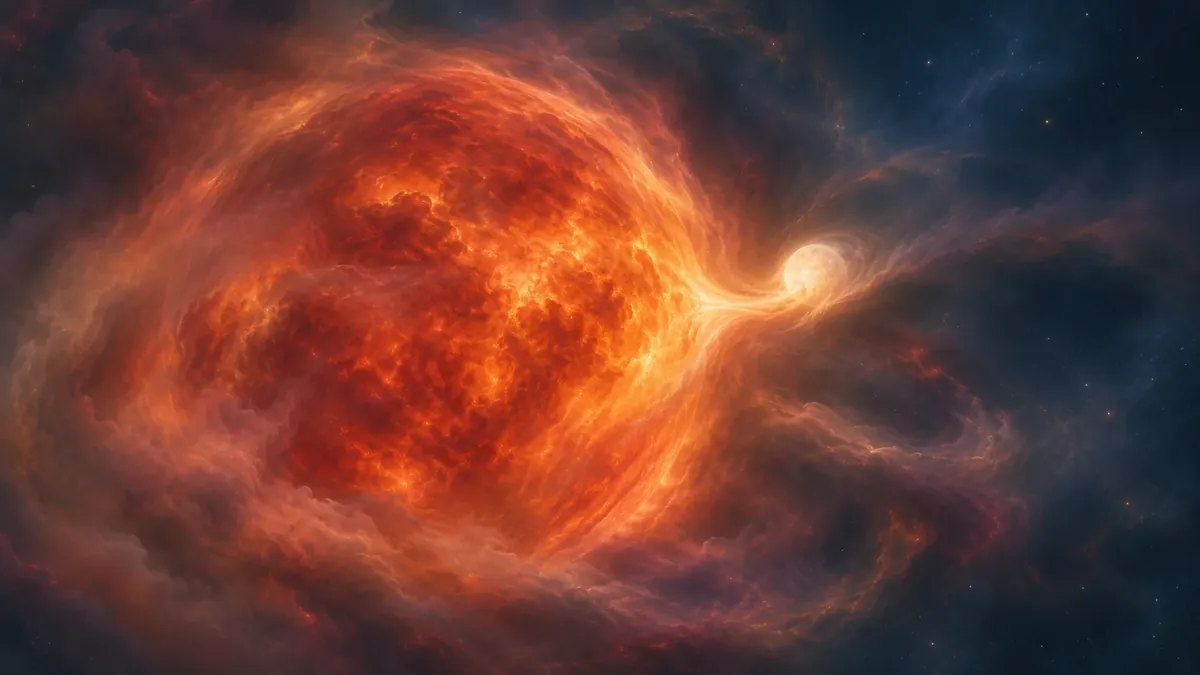
Research announced on November 18 reconstructs the merger of two stars in the Andromeda galaxy using observations gathered before, during and after their eruption. The system, nicknamed Bao, paired a large, extended star with a smaller companion. NASA says Webb observations helped establish that the companion merged into the larger star.
The news is the research result, not a collision that happened this week. Researchers noticed unusual behavior in 2023, followed the system through its 2025 eruption and used a Webb follow-up 47 days after the eruption's peak. The study was published in Nature on November 18, according to NASA.
The evidence came from different stages
Viraj Karambelkar of Columbia University led the study. NASA's account describes a reconstruction combining telescopes in space and on the ground, with Webb's mid-infrared observations helping the researchers understand the dust surrounding the system.
That dust carries information about material lost by the larger star. It is not simply an obstacle hiding a more useful picture. The team compared the observations with evolving simulations to identify a model consistent with the evidence.
The distinction separates the result from a literal movie of two visible stars colliding. Observations taken at different times and wavelengths constrain the explanation; simulations connect them into a physical account of the merger.
A small companion inside a much larger star
NASA reports that the team's reconstruction put the larger star at about seven solar masses before the eruption, with a radius around 350 times the Sun's. The smaller companion's estimated mass was about 0.7 solar masses. These are research estimates, not direct measurements of two stars placed side by side.
As the smaller star interacted with the larger star's outer layers, it entered a shared gaseous envelope. Drag removed orbital energy as it spiraled inward. In this case, the researchers concluded that the stars merged rather than surviving as a tighter pair.
NASA says the final process followed about seven orbits, roughly seven years, after the smaller star contacted the giant's surface. That interval belongs to the reconstruction. It should not be confused with the date of the new paper.
What the result leaves open
The >NASA account (opens in a new tab) says further observations are needed to determine how the merged star settles. The result therefore does not supply a finished description of Bao's future.
Its value is that an unusually complete sequence of evidence can test explanations of how binary stars interact. The more researchers can compare a model with conditions before and after an eruption, the less that explanation depends on interpreting a bright outburst alone.
 Felix Honigwachs