Perseverance is still talking to Earth, but its radio trouble has paused science
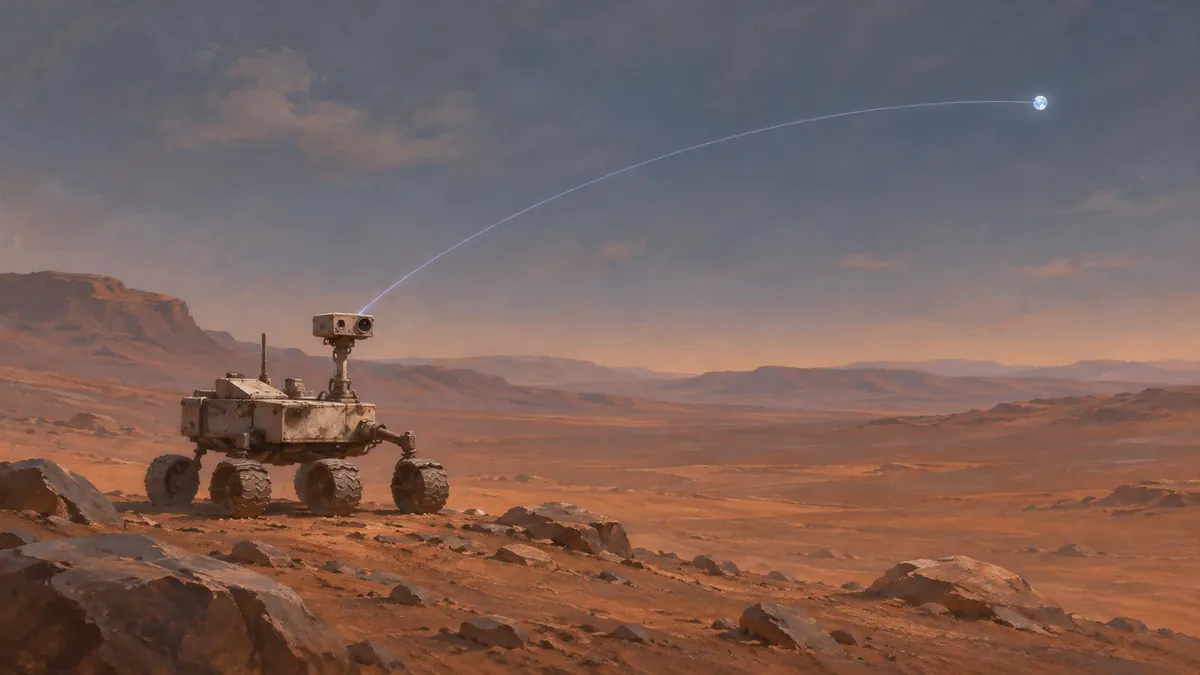
Perseverance remains stable and in contact with Earth, but NASA has paused its science work while engineers investigate problems with both UHF radios. The rover is using a slower direct connection to send the information needed for troubleshooting. That distinction explains why a mission can remain reachable while its flow of new science and pictures stops.
NASA's November 19 update describes an ongoing investigation, not a newly occurring failure that day. The initial problem appeared on October 30. The agency hopes to resume science by the end of November, but has not announced a confirmed restart.
A backup worked, then raised another question
According to NASA, the primary downlink radio failed to send its routine status signals to the rover's computer when switched on for operations. After 25 missed signals, roughly 100 seconds, the onboard protection system turned that radio off, selected the duplicate unit and put the rover into safe mode. Nonessential systems shut down in that protective state.
Engineers subsequently recovered the rover from safe mode and examined its diagnostic information. They found that the backup radio was transmitting at about half its expected power. Both UHF units are now out of use while the team evaluates their condition and whether either can safely return to service.
The sequence matters: switching to a spare does not itself prove that normal operations have been restored. In this case, the redundant equipment helped the team respond to the first fault, but its own performance required investigation. NASA has not identified a common cause for the two radio problems.
Why contact continues while new images stop
The UHF radios normally move large quantities of information through orbiters that relay it to Earth. Perseverance also has a high-gain antenna that can communicate directly with NASA's Deep Space Network using X-band radio.
NASA says that direct route has a substantially lower data rate. The team is reserving available bandwidth for diagnostics, so science and instrument operations are paused. The rover is not collecting new camera imagery during the pause, which affects the public raw-image feed.
A quiet image page therefore needs to be read alongside the engineering update. It is not, by itself, evidence that Earth has lost contact with the vehicle. Equally, continued communications should not be mistaken for a return to the normal observing program.
Odyssey has a separate recovery problem
The same NASA update describes a different fault aboard the Mars Odyssey orbiter. A reaction wheel stopped spinning, leaving the spacecraft dependent on thrusters for orientation while engineers investigate. One of its original four wheels had already failed in 2013; at least three are needed for wheel-based orientation.
NASA estimates that available hydrazine could support thruster-only orientation for one to two months, an estimate still being refined. A test made the troubled wheel move, but further testing is needed to establish whether it can be recovered. Its science instruments remain offline.
These are separate technical investigations. The report does not establish that Odyssey caused Perseverance's radio difficulties. For both missions, the next meaningful milestone is an explicit operational update, rather than a calendar target being treated as an accomplished recovery. The >NASA mission update (opens in a new tab) is the primary status source.

 Felix Honigwachs