US Personnel Take Shelter at RAF Lakenheath After Suspected Drone Activity
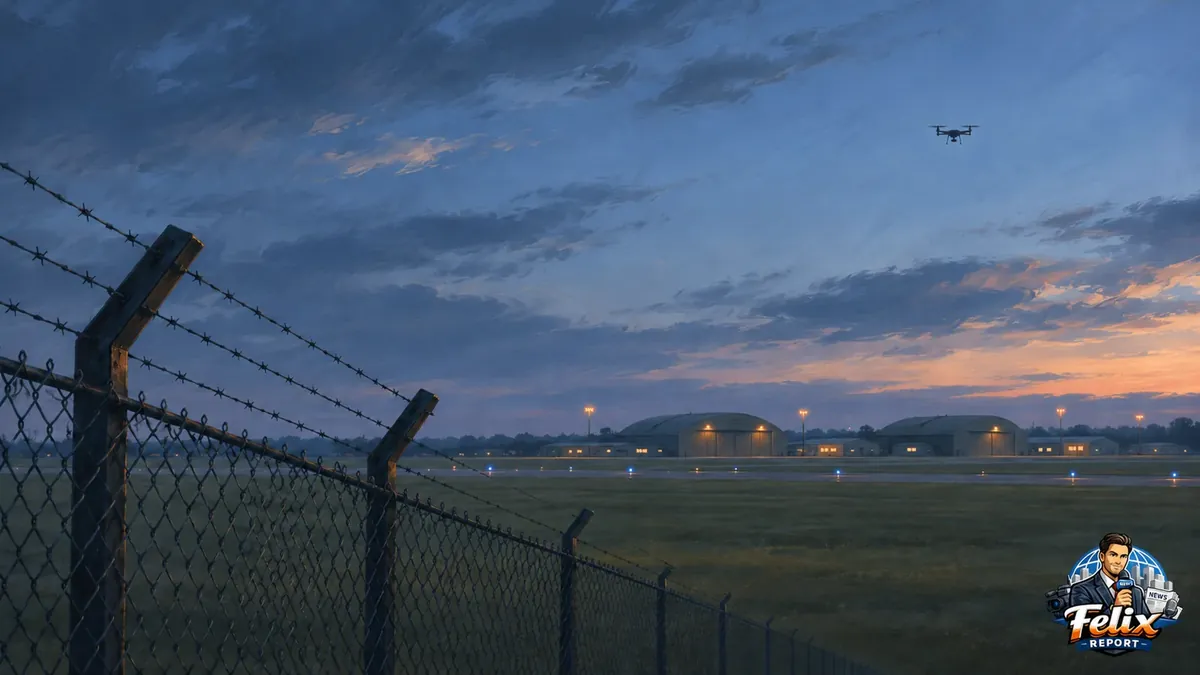
US personnel were ordered to shelter at RAF Lakenheath in Suffolk on Friday evening, November 13, after suspected unauthorized drone activity prompted a security response. The US Air Force said personnel, aircraft and infrastructure were unaffected.
Sky News reported seeing an alert directing people on the base to the nearest shelter-in-place room. Sirens were reported nearby, while West Suffolk MP Nick Timothy said the authorities had told him the incident was resolved and there was no threat to the public.
The alarm came during a week of increased protection at American military installations in eastern England. It also followed aircraft relocations from nearby RAF Mildenhall amid reports of a threat linked to Iran, a separate development that helps explain the security backdrop but does not establish responsibility for Friday's incident.
A shelter order during an already tense week
The immediate response focused on protecting people inside the installation. The US Air Force statement published by Sky News described suspected unauthorized drone activity, while Associated Press separately reported that US European Command confirmed a security response and no impact on personnel or equipment.
The published statements did not identify an operator, describe a recovered drone or attribute the activity to Iran. They establish the military's response and its assessment of the immediate consequences, rather than the identity or intentions of whoever may have been involved.
Timothy's public message also addressed people outside the perimeter. According to The Sun, he urged residents to report suspicious activity and encouraged British and American authorities to share information as freely as operational security allowed. His assurance concerned the resolved incident and public safety, not a declaration that the wider security concerns had ended.
On November 9, a US official had already told The War Zone that enhanced protection measures were operating at both Lakenheath and Mildenhall. The official said the two countries were coordinating to protect personnel, families and local communities, but declined to describe the measures themselves.
Aircraft left Mildenhall, while Ospreys arrived at Lakenheath
The earlier aircraft movements involved a different starting point. Reuters reported that at least 10 KC-135R refueling aircraft departed RAF Mildenhall on Monday, November 9. Some flew to Germany, Spain and Scotland, while Osprey aircraft moved to Lakenheath, roughly four miles away.
Reuters said it had verified footage showing two Ospreys taxiing after landing at Lakenheath. That sequence matters: the base affected by Friday's alert had received aircraft from its neighbor. The reported departures cannot simply be described as a prior evacuation of aircraft from Lakenheath.
The two sites also serve different military functions. Lakenheath hosts F-15E Strike Eagle and F-35A Lightning II fighters. Mildenhall is a hub for aerial refueling and special operations, among other missions. The War Zone identified the 100th Air Refueling Wing, which operates KC-135 tankers, as Mildenhall's host unit.
Sky News, citing The Wall Street Journal, reported that the relocations followed a threat linked to Iran, whose precise nature remained under discussion among US officials. US European Command's public response to Reuters was narrower: aircraft move between locations for various reasons, and protective arrangements are not discussed in detail for operational security reasons.
What the higher protection level means
Reporting earlier in the week also placed Lakenheath and Mildenhall at Force Protection Condition Charlie, usually shortened to FPCON Charlie. The Wall Street Journal reported that change, according to both Reuters and The War Zone. It is the second-highest level in the US military's five-level system.
The US Army's public explanation says Charlie applies when an incident or intelligence indicates that terrorist action or targeting of personnel or facilities is likely. Delta, the highest level, applies locally when an attack has occurred or intelligence indicates a specific attack is imminent.
That distinction helps explain why substantial precautions can be taken before an attack is established. A protection level is a framework for security measures based on the assessed threat. It is not, on its own, a finding about the cause of a particular alarm or the nationality of a suspected operator.
The Army's guidance describes possible consequences of higher protection levels, including more security personnel or changes at entry gates. Those are general explanations of the system, not a list of measures confirmed at Lakenheath on Friday. The US official speaking to The War Zone had specifically declined to disclose the bases' arrangements.
Drone restrictions were already in place
Public aviation notices show that restrictions on unmanned aircraft preceded the evening alert. A NATS briefing available on November 13 listed a temporary restricted area around Lakenheath extending five nautical miles from the base, from the surface to 1,200 feet above mean sea level.
The notice required permission from Lakenheath's air traffic control unit for drone flights within that area. Its stated validity ran from November 12 at 10:02 GMT until November 18 at noon GMT. A separate notice covered Mildenhall, also with a five-nautical-mile radius and a 1,200-foot upper limit.
These published boundaries explain the rules in the surrounding airspace. They do not identify the origin of Friday's suspected activity, and their appearance before the incident means they should not be presented as restrictions newly imposed in response to that evening's alarm.
The notices concern unmanned aircraft specifically. Their wording does not amount to a statement that all military flying had stopped or that either base had been evacuated. The distinction is relevant when airspace notices circulate alongside reports of aircraft movements and security alerts.
Britain had reinforced protection beyond the runway
The broader issue had reached Parliament the previous day. In a >November 12 statement to MPs (opens in a new tab), defence minister Luke Pollard said protection had been strengthened after incidents at RAF Fairford and RAF Molesworth, including at installations hosting American forces.
Pollard described additional policing, guarding and specialist support where required. He said the approach combined physical protection, access controls, surveillance, aerial monitoring and counter-drone capabilities, with arrangements reviewed against intelligence and the changing threat picture.
The minister outlined £470 million over four years for security technology and infrastructure at military sites, alongside more than £750 million for short-range counter-drone protection in Britain and for deployed forces. These were wider investment commitments described before Friday's incident, rather than emergency spending announced in response to it.
Protection also extends to the communities around the bases. Pollard told MPs that threats to US personnel living outside military installations were taken seriously and described close cooperation between British and American security institutions. That gives the issue a civilian dimension beyond the aircraft visible on a runway.
Earlier drone reports form part of the background
Lakenheath, Mildenhall and nearby RAF Feltwell had been the subject of a parliamentary question about drone activity in November 2024. In a written answer on March 5, 2025, Pollard said Ministry of Defence Police was leading the investigation in cooperation with allies and civilian authorities.
That earlier official record shows that drone-related security concerns around these installations predate the latest relocations and Friday's alert. It does not establish that separate incidents had a common operator, purpose or foreign sponsor. The investigations and the dates should be kept distinct.
For people on the base, Friday's immediate development was the instruction to take shelter and the subsequent assurance that no personnel, aircraft or infrastructure had been affected. For the wider community, Timothy's reported message was that the incident had been resolved without a threat to the public. Those updates sit within a continuing review of how Britain and the United States protect shared military sites.

 Felix Honigwachs